
African negotiators went to Glasgow with an ambitious list of demands to fight climate change, but experts say the outcome of the summit was not enough to avert a climate disaster.
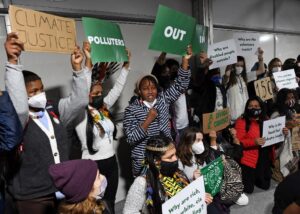
In a year where wildfires, cyclones and devastating floods dominated the news cycle, the stakes were particularly high for Cop26, and millions of Africans whose fate depended on its results.
The 12-day UN Conference of the Parties, held in Glasgow, Scotland, made some progress towards reducing the world’s carbon footprint, but left African policymakers, climate activists, developing countries and small island states disappointed.
Although Africa only contributes about 4% of all global emissions, scientists say it is the continent most threatened by climate change. Alert to the mounting risks of inaction, Africa’s group of negotiators in Glasgow, led by Gabonese chair Tanguy Gahouma-Bekale, pushed for ambitious emissions reductions targets and huge financial support from the developed world.
Concrete wins for Africa
As at most Cop summits, the tense negotiations overran – with a deal struck over 24 hours after the expected deadline. The resulting Glasgow Climate Pact, signed by 197 countries, called on governments to curb emissions and for richer nations to double funding to protect countries most at risk from climate change.
Yet in an early sign that the agreement had not achieved its full potential, Cop26 president Alok Sharma fought back tears and offered an emotional apology for last-minute changes in the climate agreement, in which China and India called for the terminology on “phasing out” coal to be watered down to “phasing down”.
Still, there were several concrete wins for Africa. Among the positives for Africa were commitments by countries to end deforestation by 2030 and a scheme agreed by 100 countries to cut 30% of methane emissions – responsible for a third of man-made global warming – by 2030, says Akankwasah Barirega, executive director at Uganda’s National Environment Management Authority.
Furthermore, $1.5bn was pledged by 10 countries, the European Union, and the Bezos Earth Fund, to protect and restore the Congo Basin, the world’s most important carbon sink, which absorbs 4% of all global emissions each year. That is part of a wider deal by 100 nations to halt and reverse deforestation by 2030 – another win for Africa.
A ‘mixed bag’
But James Reeler, WWF South Africa’s senior climate specialist, says that Cop26 was “something of a mixed bag” for the continent.
“At some level there were promising outcomes, with the first ever explicit mention of fossil fuels reduction in a Cop outcome document, improved (though still inadequate) ambition around adaptation (which aims to build nations’ resilience to the impacts of climate change), and a resolution for all countries to bring improved ambition in the form of nationally determined contributions (NDPs) to the next COP in 2022,” he tells African Business.
Barirega says other positives include the agreement on how to implement Article 6 of the Paris Agreement, which paves the way for carbon markets to operate and is a good result for heavily forested African countries like Gabon, the Democratic Republic of Congo and Cameroon, who will now find it easier to sell carbon credits on international markets to protect and maintain their forests.
There were also pledges for capacity building and technology transfer to African countries, as well as for the adaptation fund and other bilateral commitments to support developing countries in responding to climate change.
“The commitment to reduce emissions and phase down coal is a big relief for African countries. The enhanced transparency framework conclusion was also a big score for Africa,” Barirega says.
On 1 November, at the beginning of the conference, G20 leaders agreed to end financing for international coal plants by the end of the year during a summit in Rome. However, there was no move to end domestic coal power. One of the main controversies of Cop26 was China and India’s call for the language on coal in the final agreement to be changed. Sharma called on the two countries to explain themselves to climate vulnerable nations.
“It was a very big disappointment for the entire world because coal is the leading cause of emissions,” says Barirega. “We would have loved to see the two take a bold step to reduce global emissions.”
Moving away from coal
But there were some positives for Africa in transitioning away from coal. South Africa, the continent’s largest coal producer, secured investments and loans of $8.5bn from international partners to transition from coal to green energy.
Asked how South Africa plans to spend the money, the country’s minister of trade, industry and competition Ebrahim Patel tells African Business: “We’ve made some good progress in the discussions on the package. We don’t think we’re there yet in terms of the total quantum of resources required and we’re going to work on three steps.
“The first is to enable our big energy utility, Eskom, to reduce its carbon emissions. The second one is to stimulate development of the green hydrogen economy. Because South Africa is well positioned, it’s got enormous sources of renewable energy that can help to produce the green hydrogen.
“And we have the platinum group metals, which act as a catalyser, so it’s a new demand opportunity for South African metals. And the third area is a transition of our auto industry to electric vehicles.”
Asked when South Africa plans to phase out coal for good, Patel says: “I’m not going to comment on how we’re going to deal with each element of the roadmap, but we do regard climate change as fundamental, that the signs indicate the need for bold action by countries. And we’ve been disappointed that many developed countries have not had a sufficiently ambitious commitment to finance.”
Reeler calls the $8.5bn deal “significant”, given that South Africa is responsible for nearly a third of the continent’s emissions.
“In addition, as the largest single tranche of climate finance to date (by a large margin), it indicates that there is a growing cognisance and desire within developed nations to address their obligations under the UNFCCC’s principle of ‘common but differentiated responsibilities and respective capabilities’,” Reeler says.
Private sector shows the money
The talks again focused attention on the crucial role of the private sector in the fight against climate change. UN envoy on climate action and finance Mark Carney helped secure a pledge that banks, investors and insurers representing $130 trillion in assets decarbonise their businesses by mid-century.
There were some promising philanthropic pledges, including $2bn from Amazon founder Jeff Bezos’ Earth Fund. The Bezos Earth Fund also joined the Rockefeller Foundation and IKEA Foundation as an anchor philanthropic organisation for the Global Energy Alliance for People and Planet (GEAPP), which aims to accelerate investment in green energy.
Investment partners on the project include the African Development Bank Group, the European Investment Bank and the World Bank. Over the next decade, GEAPP looks to unlock $100bn in public and private capital to go towards adapting to climate change.
“The global private sector stepped up with many corporations making net zero commitments, financial markets seeking to do a lot more with aligning with net zero and acting stronger with respect to using capital to motivate change,” Tariye Gbadegesin, managing director of ARM Harith Infrastructure Fund tells African Business.
Key targets missed
But key finance targets were missed elsewhere. Developed countries still haven’t met a target set 12 years ago to invest $100bn towards developing countries’ climate adaptation and mitigation needs. Many also believe $100bn allocated between at least 46 countries to finance adaptation and resilience to climate change is not enough.
“There is lack of capacity and the complexity of the process to access the already scarce finance has made it difficult for developing nations,” Ethiopia’s transport minister, Dagmawit Moges, who was at the negotiating table at Cop26, tells African Business.
“$100bn was not met because developed countries did not meet their obligations and some have also suggested it’s likely they might not meet the target until 2023,” she adds.
The African Group of Negotiators argued that developed countries should be providing $700bn a year in funding instead – an ambitious target that went unmet. Many African climate negotiators believe that without this critical finance, countries on the continent may struggle to meet their NDCs.
Ibrahima Diong, United Nations assistant secretary-general and director-general at African Risk Capacity, was present to discuss financing for disaster relief on the continent. Asked about the private financing commitments being unmet, he tells African Business: “It’s not just about the funds being committed and mobilised; once the funds mobilise, the question is availability, accessibility and affordability for Africans.”
Gbadegesin says the $100bn “should be a floor and not a ceiling” because the cost of the global climate transition is estimated to be between $100 trillion and $130 trillion.
“For Africa alone, just the cost of energy access is $100bn, so $100bn across developing economies – it’s not enough. Nigeria estimated the cost of its energy transition to net zero over 30 years to be $400bn, so it’s just not enough, and the developed economies really need to do better.
“Not only did the commitment fall short, there are great concerns with accessibility and relevance of that capital. Many developing economies were just complaining through the hallways of Cop about how virtually impossible it is to access even the little amount of capital that is committed.”
Reeler says that loss and damage – the contentious issue of “insurance” type payouts to vulnerable countries to address climate impact – “hardly made a showing”, with no financial backing despite a strong push from developing countries.
Barirega observes that “the negotiated text doesn’t put a binding obligation to the developed world to pay for damage caused by their actions,” adding that there was a failure at Cop26 to resolve the issue of liability and redress for damage.
Just rhetoric?
The world is currently 1.1°C warmer than it was at pre-industrial levels. If mankind is able to keep this temperature down to 1.5°C, in line with the 2015 Paris Climate Agreement, many more commitments will have to be made and countries will have to work harder to phase out fossil fuels and transform to green economies.
If the Cop26 pledges are met, temperature rises could be reduced to 1.8°C, but currently, the world is heading for 2.4°C of warming by the end of the century, which would dramatically change the earth’s climate and lead to at least a billion people being affected by deadly “extreme heat stress”, according to the UK’s Met Office.
“The commitments [at Cop26] remain largely rhetoric without any binding force to honour the pledges. This is a total failure to take responsibility for our actions,” Barirega says.
Indeed, many of the key pledges were non-binding, including the pledge from only 40 nations to wind down coal power by the 2030s (or 2040s for developing nations), the pledge to prevent all deforestation by 2030, the pledge to cut methane emission by 30% by 2030, and the $130 trillion in assets committed by financial institutions to align their investment strategies with the 1.5°C strategy.
“Seeing these sorts of pledges actually reflected in the Cop text – and therefore given teeth – will make a huge difference to the likelihood of our actually achieving the goals of the Paris Agreement,” Reeler says.
Hopes for COP27
With the clock counting down to Cop27 in Sharm el-Sheikh next November, it is vital that the conference addresses the gaps in Cop26’s outcomes. African negotiators are confident that the next meeting in Egypt will inject fresh impetus into the negotiations, leading to solid climate commitments to the continent.
“Our expectations for Cop27 are 1) there will be definite financial commitments, 2) coal will be phased out, 3) countries will honour their pledges, and 4) liability and redress will be agreed,” Barirega says.
Ethiopia’s Moges says: “I believe this next Cop will be the event where African countries will join hands and advocate for the climate justice which our continent needs. In addition, it is my belief that that Cop will be the event where important and historical decisions which have been hanging over the past events will get finalised.”
But others are less optimistic. “Overall, the Cop26 outcome is the best we have had for a long time, but it’s not sufficiently ambitious to deal with the current climate crisis, and largely leaves developing nations out in the cold when dealing with climate change, which does not gel with the founding principles of the UN Framework Convention on Climate Change – that those countries responsible and capable of dealing with the crisis must take more action and support others,” WWF’s Reeler says.
He says that it is a “saving grace” that the door is open for increased ambition next year, rather than locking in Cop26’s goals for another five years.
“For African countries, a critical issue is the availability of finance to facilitate a just transition to a low carbon economy, to enable better adaptation measures, and to fill the gaps through loss and damage. Globally, all nations need to up their ambition and provide firm commitments to reduce emissions and ensure climate change of no more than 1.5°C is feasible.”
Originally Published by African Business
Related Posts
Ivor Ichikowitz documents Winnie Mandela’s trials through her voice
Documentary draws from exclusive interviews and archival footage to capture…
Uganda welcomes return of 39 artefacts from Museum of Archaeology and Anthropology
Headdress and pots among colonial-era objects sent back in ‘landmark’ loan…
Uganda: The Secret in the Eyes of Gorillas in the Impenetrable Forest
Thirty years ago, Uganda welcomed its first tourists in search of mountain…
Read Published Stories and Articles from Top Media Houses